P1 Registration Shake-Up: 12 Popular Schools to Set Aside Places for Kids Living Beyond 2km
From the 2027 P1 registration exercise, 12 popular primary schools will split their Phase 2C places equally between children living within 2km and those living further away. Here is what it means for home buyers.
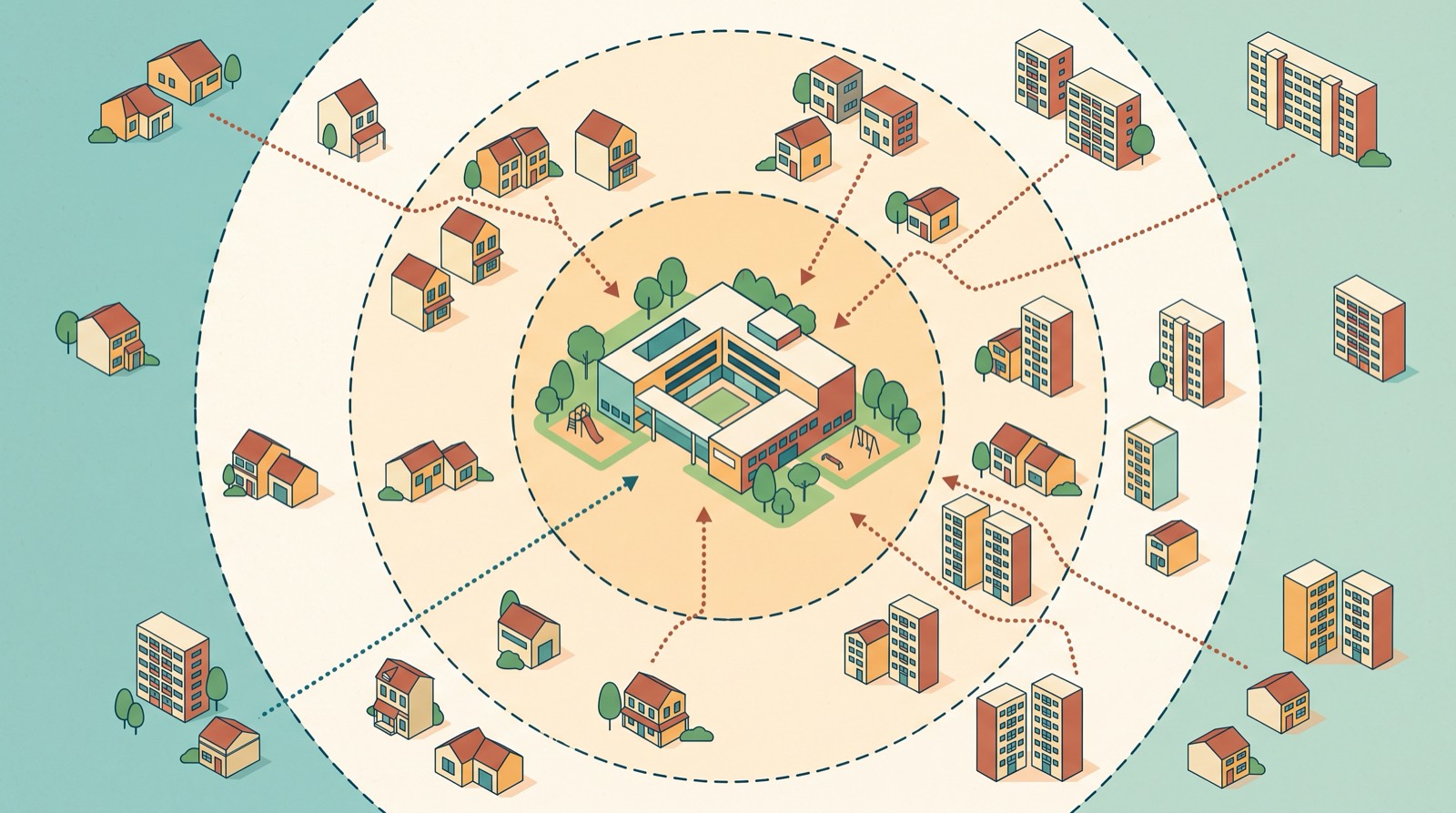
If you are planning for Primary 1 a few years from now, there is a big change coming. Starting with the 2027 P1 Registration Exercise, some of Singapore's most sought-after primary schools will set aside places for children who live more than 2km away. The Ministry of Education (MOE) announced the change on 10 September 2026, and it is the biggest tweak to the P1 registration framework in years.
If you own a home near one of these schools, or you are thinking of buying one because of the school, it is worth understanding exactly what changed. The familiar “stay within 1km” strategy no longer works the same way at these 12 schools.
What is changing
The changes apply to Phase 2C, the stage for children who have no prior connection to a school. Two things are happening:
- More reserved places. Phase 2C places go up from 40 to 60 at almost every school. Schools with fewer than 180 P1 places — 27 of the 179 schools open for registration in 2026 — keep 40.
- A new two-track scheme at 12 schools. At these schools, the 60 Phase 2C places, plus any left over from earlier phases, are split equally: half for children living within 2km of the school, half for children living more than 2km away.
- No distance priority inside each track. How far you live no longer matters once you are in a track. A child living 500m away has no edge over one living 1.5km away.
- No maximum distance. There is no upper limit on how far away a family can live under Phase 2C.
- Citizenship still counts. Singapore Citizens are admitted before Permanent Residents, and balloting is used if a track is oversubscribed. Leftover places in one track flow to applicants in the other track.
The 12 schools on the two-track scheme
The scheme will apply to these schools from the 2027 exercise, for children starting P1 in 2028:
- Anglo-Chinese School (Junior)
- Anglo-Chinese School (Primary)
- CHIJ (Katong) Primary
- Methodist Girls' School (Primary)
- Nanyang Primary School
- Ngee Ann Primary School
- Pei Hwa Presbyterian Primary School
- Raffles Girls' Primary School
- Singapore Chinese Girls' Primary School
- St. Margaret's School (Primary)
- Tanjong Katong Primary School
- Tao Nan School
Why these 12 schools
MOE picked schools in neighbourhoods where public housing makes up less than 40% of homes within 2km — far below the national average, where about four in five residents live in HDB flats. In these areas, such as Bukit Timah, Newton and Marine Parade, distance-based priority was mostly helping families who were already likely to apply, so it did little to widen the mix of students. MOE will review the list periodically, and Anglo-Chinese School (Primary) will drop off it when it moves from Barker Road to Tengah in 2030.
What it means for home buyers
Here is the property angle.
- The 1km premium is diluted at these 12 schools. For Phase 2C, a home within 1km no longer outranks a home 1km to 2km away at these schools. If you were paying a premium purely for a 1km address, that edge is now narrower.
- Within 2km still helps. Half the Phase 2C places are still reserved for families living within 2km, so proximity is not worthless — it now puts you in a track rather than ahead of everyone.
- Beyond 2km is in play. Half the Phase 2C spots at these schools are reserved for families living more than 2km away, so distance alone is no longer a barrier to a place there.
- The other schools are unchanged. At schools not on the list, the usual order — distance bands first, then citizenship — still applies in Phase 2C.
- Early phases still reward ties. Phases 1, 2A and 2B are largely unchanged, and those children are admitted before Phase 2C, so alumni and community links keep their value.
- About one in four places is now open. MOE says that in a typical primary school with roughly 240 P1 vacancies, about a quarter of places will be open to children regardless of whether they have prior connections to the school.
The bottom line
For most families, the practical change is simply that more places are up for grabs in Phase 2C. For buyers eyeing the 12 schools, the old rule of thumb — get within 1km — is no longer the whole story. Distance still matters, but a lot more now depends on the track your address falls into.
Have a question about this article? Chat with me and I'll get back to you as soon as possible.
Sources
- The Straits Times – P1 registration: More Phase 2C places from 2027; 12 schools to keep spots for kids living farther away
- The Straits Times – What the 2027 P1 registration changes mean for your child
- AsiaOne – 12 schools in areas with less public housing to get new 2-track scheme from 2027
- Ministry of Education – How distance affects priority admission for P1 registration