Rents Are Still Rising — Just at a Gentler Pace
If you're a tenant wondering whether the rental madness is finally over, here's the honest answer: it's cooling, but not exactly cheap yet.
URA released its full Q2 2026 real estate data on 24 July, and the headline is that private residential rents rose 0.7% quarter-on-quarter — slightly faster than the 0.3% increase in Q1. That brings total rental growth for the first half of 2026 to 1%, just a hair below the 1.2% we saw in H1 2025.
So rents are still going up. But the pace is much more moderate than the double-digit surges we saw in 2022–2023, and some segments are already starting to soften.
Landed Properties Are the Big Winner This Quarter
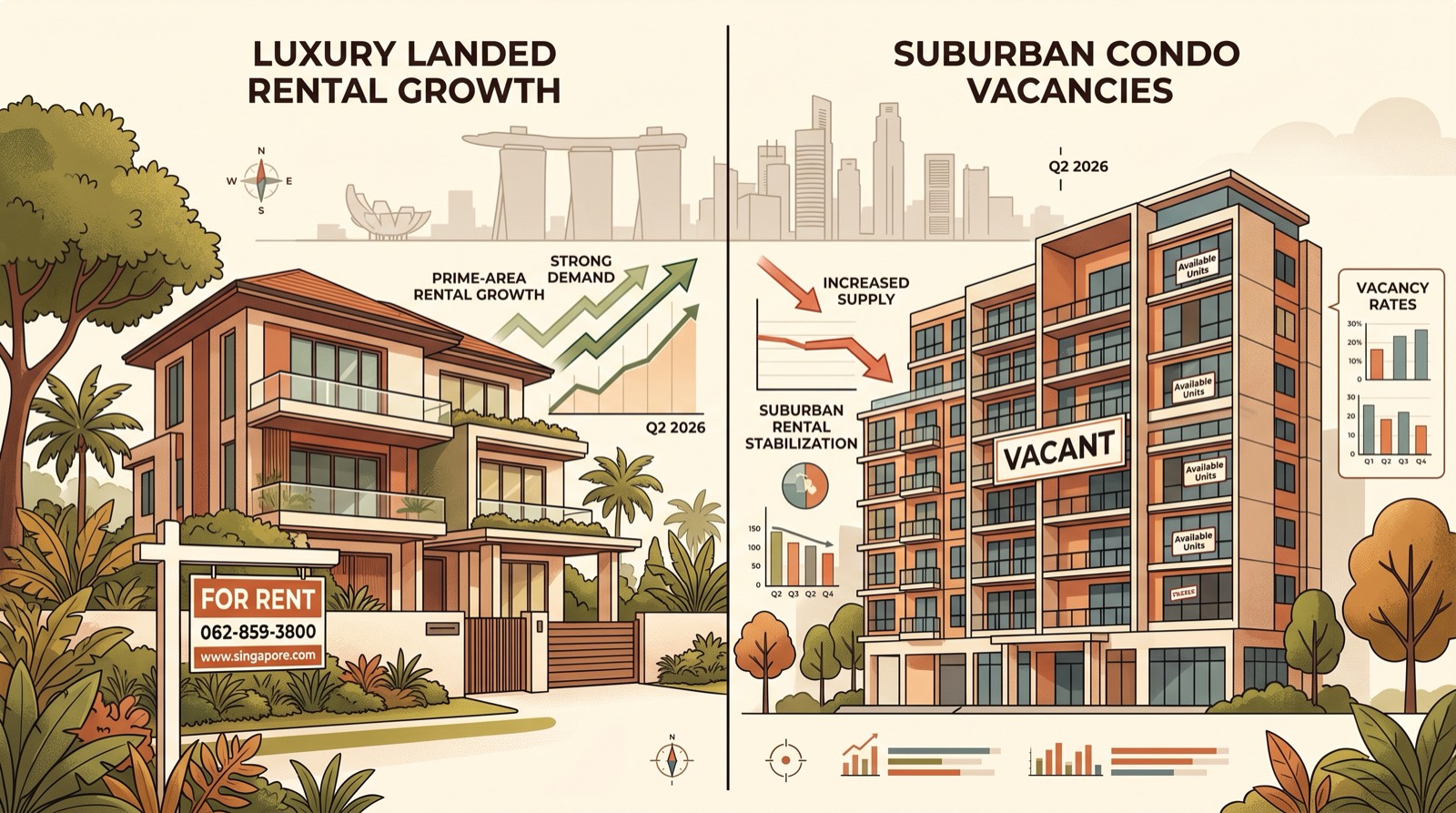
Not all rents moved the same way. The biggest jump came from landed homes, where rents surged 2.7% in Q2 — a sharp turnaround from the almost-flat 0.1% gain in Q1.
Analysts point to sustained wealth migration into Singapore as a key driver for landed and prime-area properties. More high-net-worth individuals are moving here, and they need somewhere to stay while they look for a home to buy — or sometimes, just rent long-term.
Condos: A Mixed Picture Across Regions
For non-landed homes, rental growth was flat overall at 0.4%. But behind that number lies a split story:
- Core Central Region (CCR) — rents are holding up well, driven by limited supply and expat demand. No new CCR launches in Q2 kept existing units in demand.
- Rest of Central Region (RCR) — rents were unchanged after dipping 0.2% in Q1. The mid-tier market seems to be finding its footing.
- Outside Central Region (OCR) — rents slipped 0.3%, reversing the 1% gain in Q1. More supply hitting the suburbs means tenants have more choices.
If you're renting in the city centre, you're still feeling the squeeze. But in the suburbs — especially areas with new completions — you might actually have some bargaining power.
More Completions on the Way — What That Means for Tenants
One reason rents haven't shot up like before: more homes are being completed. In Q2, 1,212 private housing units (including 512 ECs) were finished. While that's about half the quarterly average of recent years, it's still adding to available stock.
Looking ahead, about 5,012 private homes (including ECs) are expected to be completed in H2 2026, mostly in the RCR and OCR. That's good news for tenants — more supply usually means more room to negotiate.
The bigger wave comes in 2027–2028, with around 8,400 and 9,900 units (excluding ECs) expected to be completed respectively. That could tip the scales further in favour of tenants.
The Vacancy Rate Crept Up — But Rental Volume Grew
The vacancy rate edged up to 6.4% at end-Q2, from 6.2% in Q1. That's still relatively low historically, but the trend is worth watching.
At the same time, rental transaction volume rose 5.1% — from 21,203 contracts in Q1 to 22,290 in Q2. So more people are renting, even as vacancy ticks up. This suggests the market is still active, but tenants are becoming more selective.
HDB Rental Market Also Seeing Movement
It's not just private homes. The HDB rental market saw 10,002 approved rental cases in Q2, up 4.9% from Q1. A total of 58,855 HDB flats were rented out as at end-Q2.
The highest median rent recorded was $5,100 for a five-room flat in the central area, while the lowest was $2,350 for a two-room flat in Sengkang.
There's also a wave of HDB flats hitting their five-year MOP this year — 13,480 in total. Many owners may choose to rent out their flats, adding more supply to the rental market and giving tenants even more options.
What Should Tenants and Landlords Expect?
For tenants, the outlook is cautiously positive. More supply is coming, especially in the suburbs, and the days of bidding wars over rental units are largely behind us. If your lease is up for renewal, it's worth negotiating — especially if you're in the OCR or RCR, where competition among landlords is starting to heat up.
For landlords, the picture is more nuanced. CCR and landed properties are still performing well thanks to limited supply and sustained demand from high-net-worth individuals. But in the mass market, rents may soften further as more units hit the market. Landlords who price realistically will fare better than those holding out for pandemic-era premiums.
One wild card: global economic uncertainty. If the macro picture worsens in H2, corporate relocations could slow and expat demand could dip, putting further downward pressure on rents.
The Bottom Line
The Q2 2026 data shows a rental market settling into a new normal — gentler growth, more supply, and a growing gap between prime and suburban segments. It's not a tenant's market just yet, but the balance is clearly shifting.
For anyone hunting for a rental in H2 2026, the key takeaway is simple: don't just accept the asking price. With more options coming, there's room to shop around.
Read the original sources:
BT: Private residential rents rise 0.7% in Q2 - https://www.businesstimes.com.sg/property/private-residential-rents-rise-0-7-q2-home-prices-inch-0-5-ura
URA Q2 2026 Real Estate Statistics - https://www.ura.gov.sg/news/media/pr26-51
ERA Research: Q2 2026 Private Residential Report - https://www.era.com.sg/research-articles/2q-2026-ura-private-residential-report